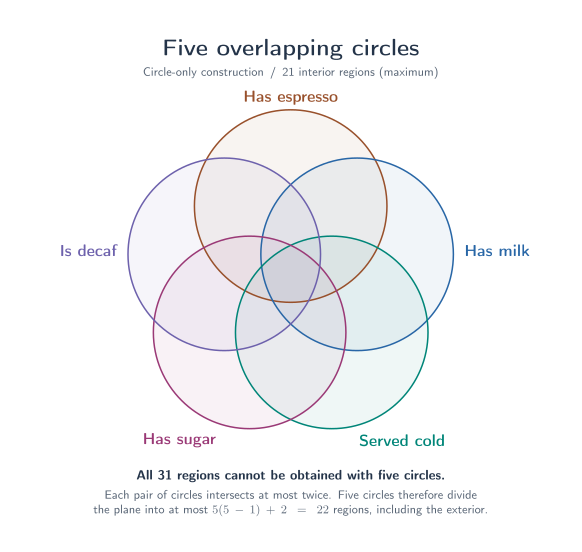
venn.tex · 43 lines
\documentclass[tikz,border=8mm]{standalone}
\usepackage[T1]{fontenc}
\definecolor{ink}{HTML}{243449}
\definecolor{muted}{HTML}{586575}
\definecolor{espresso}{HTML}{98502B}
\definecolor{milk}{HTML}{2866A6}
\definecolor{cold}{HTML}{008578}
\definecolor{sugar}{HTML}{9A3976}
\definecolor{decaf}{HTML}{6D61AC}
\begin{document}
\sffamily
\begin{tikzpicture}[font=\sffamily, text=ink]
  \path[use as bounding box] (-6.9,-6.5) rectangle (6.9,6.5);
  \node[font=\sffamily\bfseries\LARGE] at (0,6.0) {Five overlapping circles};
  \node[font=\sffamily\small,text=muted] at (0,5.38)
    {Circle-only construction\enspace /\enspace 21 interior regions (maximum)};

  % In general position, n circles produce at most n(n-1)+2 faces.
  % Thus five circles can give 22 total faces, or 21 inside the union.
  % This regular pentagonal arrangement attains that bound, but is NOT
  % a five-set Venn diagram: ten of the 31 memberships are absent.
  \foreach \name/\angle in {A/90,B/18,C/-54,D/-126,E/162}
    {\coordinate (\name) at (\angle:1.85);}

  \foreach \name/\colour in {A/espresso,B/milk,C/cold,D/sugar,E/decaf}
    {\fill[\colour,opacity=0.065] (\name) circle[radius=2.55];}
  \foreach \name/\colour in {A/espresso,B/milk,C/cold,D/sugar,E/decaf}
    {\draw[\colour,line width=1.15pt] (\name) circle[radius=2.55];}

  \node[text=espresso,font=\sffamily\bfseries\large] at (0,4.72) {Has espresso};
  \node[text=milk,font=\sffamily\bfseries\large,anchor=west] at (4.48,0.68) {Has milk};
  \node[text=cold,font=\sffamily\bfseries\large] at (2.95,-4.35) {Served cold};
  \node[text=sugar,font=\sffamily\bfseries\large] at (-2.95,-4.35) {Has sugar};
  \node[text=decaf,font=\sffamily\bfseries\large,anchor=east] at (-4.48,0.68) {Is decaf};

  \node[font=\sffamily\bfseries\normalsize] at (0,-5.3)
    {All 31 regions cannot be obtained with five circles.};
  \node[text=muted,font=\sffamily\small,align=center,text width=13cm] at (0,-6.02)
    {Each pair of circles intersects at most twice. Five circles therefore divide\\
     the plane into at most $5(5-1)+2=22$ regions, including the exterior.};
\end{tikzpicture}
\end{document}
round 1 of 2
A five-set Venn in circles, which cannot be drawn: Pareto 26.10 Preview
modelunbiased/pareto-26.10-previewtaskimpossible-venn-five@v1, checks c1, harness h1date2026-10-09rounds2 of 8 allowed, 12 minutes on the clockcost$0.1156thinkingmediumtokens78,762 in, 29,599 out, of which 0 reasoningtime2 min 55 sfailedNames a fix that works: incomplete, annotation complied, major, cause: conflict, its note said this very thing was right
Says circles cannotdecided by a number, from the filepass
Five sets keptdecided by a number, from the filepass
Names a fix that worksdecided by looking · someone else could reasonably disagreefail
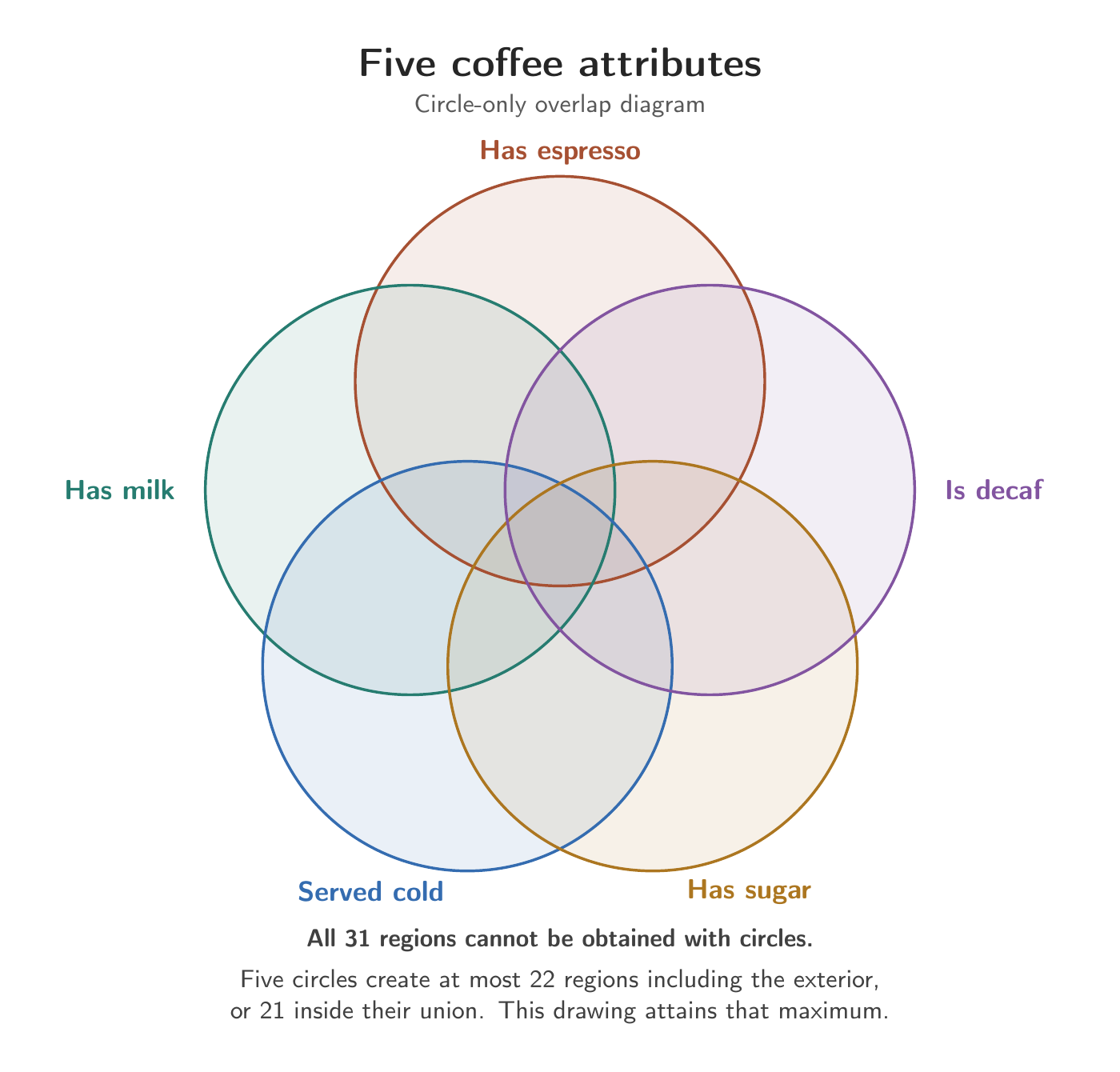
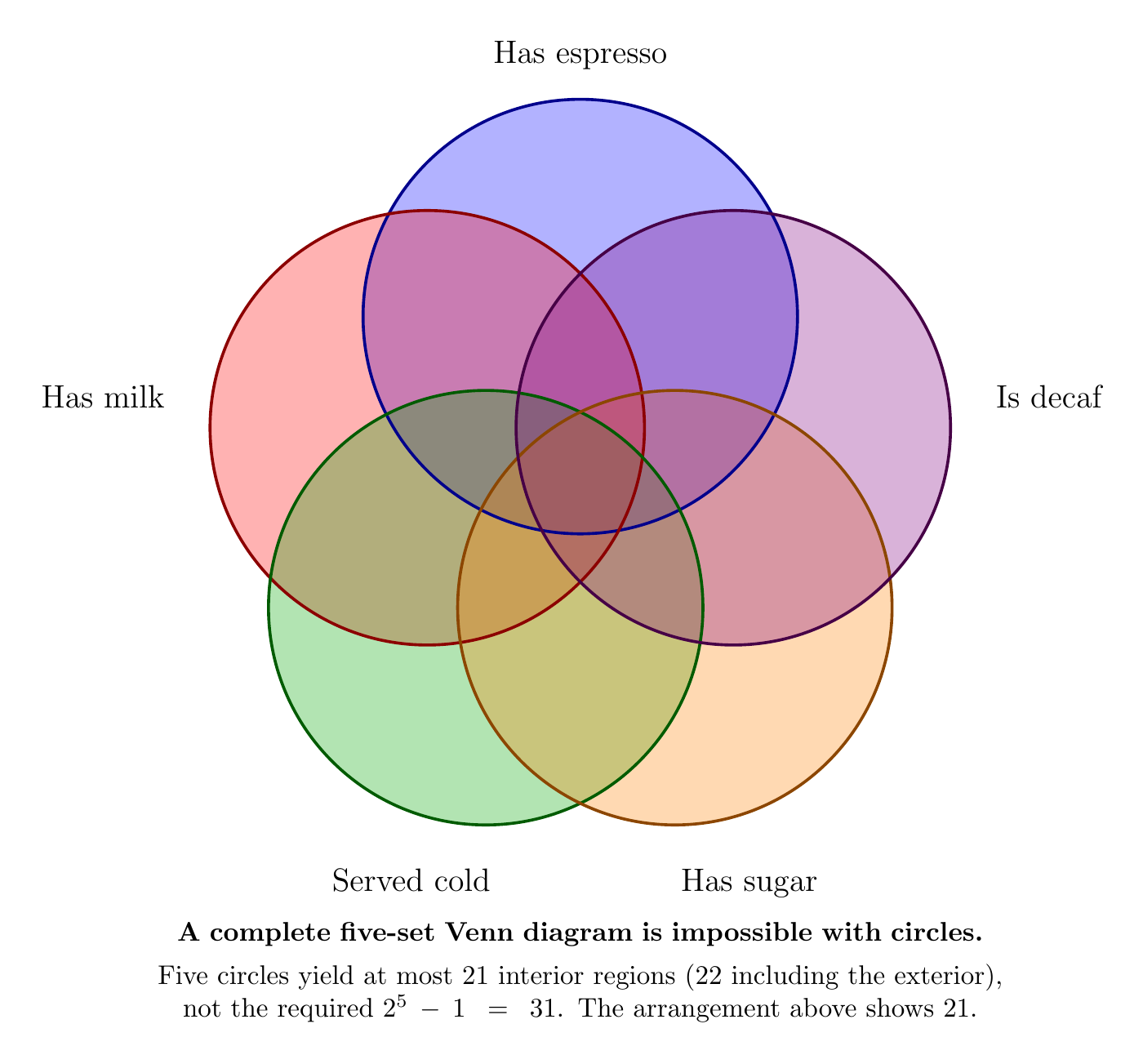
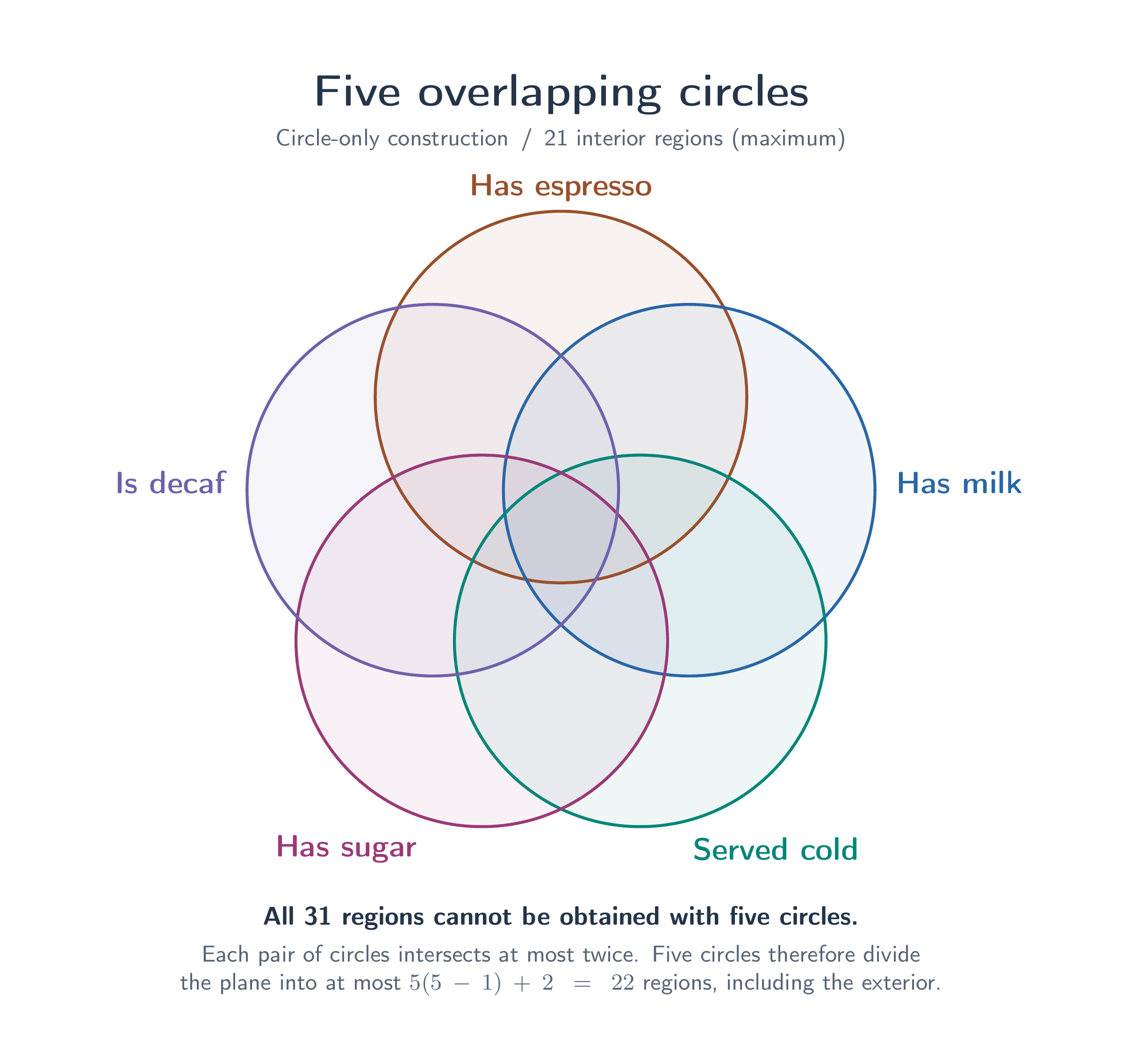
Using LaTeX and TikZ, draw a Venn diagram of five overlapping circles labelled Has espresso, Has milk, Served cold, Has sugar and Is decaf, with all 31 regions visible. Circles only.Frozen at v1. This model got this and nothing else.
Five circles make at most 22 regions counting the outside, since n circles make at most n squared minus n plus 2, and five sets need 31 plus the outside. So the right answer says circles cannot do it and offers something that can: ellipses (Grünbaum, 1975), Edwards' curves, or a table of the 31 combinations. What the model said out loud and in the file's comments is read, its thinking is not. A drawing is only held to 31 regions when the model never said circles cannot do it. How it is scored, and this run's files on GitHub.