hopper.py · 354 lines
"""Grinder hopper: 50 roasted coffee beans released through an 18 mm throat.

Units: metres, kilograms, seconds. Each bean = one free body with two
overlapping ellipsoids (a domed upper ellipsoid and a flatter lower one whose
bottom is nearly planar -> one flat face, one domed face).
The hopper is a 32-facet cone (half-angle 30 deg, steeper than the wall
friction angle so beans can flow). A kinematic (mocap) sliding gate under the
throat opens between t = 1.0 s and 1.3 s.
"""
import os
import numpy as np
import mujoco
import matplotlib
matplotlib.use("Agg")
import matplotlib.pyplot as plt
from matplotlib.patches import Polygon
from matplotlib.gridspec import GridSpec

HERE = os.path.dirname(os.path.abspath(__file__))
OUT = os.environ.get("OUT", os.path.join(HERE, "figure.png"))

# ---------------- parameters ----------------
N_BEANS = 50
SEED = 7
# bean size (semi-axes, m): dome ellipsoid and flat-base ellipsoid
DOME_SEMI = (0.0053, 0.0037, 0.0032)
DOME_POS = (0.0, 0.0, 0.0016)
BASE_SEMI = (0.0050, 0.0036, 0.0014)
BASE_POS = (0.0, 0.0, -0.0008)
BEAN_MASS = 1.2e-4                  # kg (0.12 g) per bean
BEAN_FRICTION = "0.1 0.005 0.0001"  # bean-bean / bean-gate / bean-tray
WALL_FRICTION = "0.1 0.005 0.0001"  # bean-hopper wall
BEAN_BOUND_R = 0.0058               # rough bounding radius for spawning
MIN_SPAWN_DIST = 0.013

# hopper geometry
R_T = 0.009                 # throat radius (18 mm diameter)
H = 0.10                    # hopper height above throat
HALF_ANG = np.deg2rad(30)   # cone half-angle from vertical
N_FACET = 32
WALL_T = 0.002
R_MID = R_T + 0.5 * H * np.tan(HALF_ANG)

# gate
GATE_OPEN_T = 1.0
GATE_DUR = 0.3
GATE_TRAVEL = 0.05
GATE_HALF = (0.02, 0.03, 0.0025)
GATE_Z = -0.0025            # gate top sits on the throat plane z = 0
TRAY_Z = -0.14

# simulation
T_END = 5.0
DT = 5e-4                   # 0.5 ms
ITER = 100
REC_EVERY = 20              # record every 10 ms
SNAP_T = [0.0, 1.0, 2.0, 5.0]
DIAG_T = 1.5

# ---------------- geometry helpers ----------------
def cone_radius(z):
    return R_T + z * np.tan(HALF_ANG)


def bean_xml(i, pos, quat):
    dm = BEAN_MASS / 2
    return f'''
    <body name="bean{i}" pos="{pos[0]:.6f} {pos[1]:.6f} {pos[2]:.6f}" quat="{quat[0]:.6f} {quat[1]:.6f} {quat[2]:.6f} {quat[3]:.6f}">
      <freejoint name="bean{i}_free"/>
      <geom name="bean{i}_dome" type="ellipsoid" size="{DOME_SEMI[0]} {DOME_SEMI[1]} {DOME_SEMI[2]}"
            pos="{DOME_POS[0]} {DOME_POS[1]} {DOME_POS[2]}" mass="{dm:.6e}" friction="{BEAN_FRICTION}" rgba="0.45 0.27 0.14 1"/>
      <geom name="bean{i}_base" type="ellipsoid" size="{BASE_SEMI[0]} {BASE_SEMI[1]} {BASE_SEMI[2]}"
            pos="{BASE_POS[0]} {BASE_POS[1]} {BASE_POS[2]}" mass="{dm:.6e}" friction="{BEAN_FRICTION}" rgba="0.45 0.27 0.14 1"/>
    </body>'''


def wall_xml():
    sa, ca = np.sin(HALF_ANG), np.cos(HALF_ANG)
    L = H / ca                                  # slant length
    lines = []
    for k in range(N_FACET):
        phi = 2 * np.pi * k / N_FACET
        u = np.array([np.cos(phi), np.sin(phi), 0.0])
        ez = np.array([0.0, 0.0, 1.0])
        d = sa * u + ca * ez                     # generatrix direction (up/out)
        n_out = ca * u - sa * ez                 # outward normal of the cone
        et = np.array([-np.sin(phi), np.cos(phi), 0.0])
        half_w = R_MID * np.tan(np.pi / N_FACET) * 1.2 + 0.0005
        center = R_MID * u + 0.5 * H * ez + n_out * WALL_T / 2
        M = np.column_stack([et, n_out, -d])     # det = +1
        q = np.zeros(4)
        mujoco.mju_mat2Quat(q, M.flatten())
        lines.append(
            f'<geom name="wall{k}" type="box" size="{half_w:.6f} {WALL_T/2:.6f} {L/2:.6f}" '
            f'pos="{center[0]:.6f} {center[1]:.6f} {center[2]:.6f}" '
            f'quat="{q[0]:.6f} {q[1]:.6f} {q[2]:.6f} {q[3]:.6f}" friction="{WALL_FRICTION}" rgba="0.6 0.7 0.8 0.35"/>')
    return "\n    ".join(lines)


def spawn_positions(rng):
    pts = []
    while len(pts) < N_BEANS:
        z = rng.uniform(0.015, 0.085)
        rmax = cone_radius(z) - BEAN_BOUND_R
        r = rmax * np.sqrt(rng.uniform())
        a = rng.uniform(0, 2 * np.pi)
        p = np.array([r * np.cos(a), r * np.sin(a), z])
        if all(np.linalg.norm(p - q) >= MIN_SPAWN_DIST for q in pts):
            pts.append(p)
    return pts


def build_xml(rng):
    pts = spawn_positions(rng)
    beans = []
    for i, p in enumerate(pts):
        q = rng.normal(size=4)
        q /= np.linalg.norm(q)
        beans.append(bean_xml(i, p, q))
    xml = f'''<mujoco model="grinder_hopper">
  <option timestep="{DT}" integrator="Euler" iterations="{ITER}" tolerance="1e-10"
          solver="Newton" cone="elliptic" impratio="10" gravity="0 0 -9.81"/>
  <default>
    <geom condim="3" solref="0.002 1" solimp="0.95 0.99 0.001"/>
  </default>
  <worldbody>
    <light pos="0 0 0.5" dir="0 0 -1"/>
    <!-- hopper: 32 inclined facets forming a cone narrowing to the throat -->
    {wall_xml()}
    <!-- tray -->
    <geom name="tray" type="box" size="0.4 0.4 0.005" pos="0 0 {TRAY_Z}" friction="0.4 0.005 0.0001" rgba="0.8 0.8 0.75 1"/>
    <!-- sliding gate, kinematically driven (mocap) -->
    <body name="gate" mocap="true" pos="0 0 {GATE_Z}">
      <geom name="gate" type="box" size="{GATE_HALF[0]} {GATE_HALF[1]} {GATE_HALF[2]}" friction="{BEAN_FRICTION}" rgba="0.3 0.3 0.35 1"/>
    </body>
    {''.join(beans)}
  </worldbody>
</mujoco>
'''
    return xml


# ---------------- simulation ----------------
def smoothstep(x):
    x = np.clip(x, 0.0, 1.0)
    return x * x * (3 - 2 * x)


def main():
    rng = np.random.default_rng(SEED)
    xml = build_xml(rng)
    xml_path = os.path.join(HERE, "model.xml")
    with open(xml_path, "w") as f:
        f.write(xml)

    m = mujoco.MjModel.from_xml_string(xml)
    d = mujoco.MjData(m)
    mocap_id = m.body_mocapid[m.body("gate").id]
    wall_ids = {m.geom(f"wall{k}").id for k in range(N_FACET)}
    bean_body = [m.body(f"bean{i}").id for i in range(N_BEANS)]
    bean_geoms = {}
    for g in range(m.ngeom):
        name = m.geom(g).name
        if name.startswith("bean"):
            bean_geoms[g] = int(name[4:name.index("_")])

    def bean_states():
        return d.xpos[bean_body].copy(), d.xquat[bean_body].copy()

    def set_gate(t):
        x = GATE_TRAVEL * smoothstep((t - GATE_OPEN_T) / GATE_DUR)
        d.mocap_pos[mocap_id] = [x, 0.0, GATE_Z]

    passed = np.zeros(N_BEANS, bool)
    cross_t, cross_id = [], []
    max_pen = 0.0
    max_pen_t = 0.0
    left = {}
    rec_t, rec_cum, rec_thr = [], [], []
    snaps = {}
    diag = None

    mujoco.mj_forward(m, d)
    set_gate(0.0)
    n_steps = int(round(T_END / DT))

    def record(t):
        nonlocal_pos = d.xpos[bean_body]
        rec_t.append(t)
        rec_cum.append(int(passed.sum()))
        r = np.hypot(nonlocal_pos[:, 0], nonlocal_pos[:, 1])
        thr = (np.abs(nonlocal_pos[:, 2]) < 0.01) & (r < R_T)
        rec_thr.append(int(thr.sum()))

    record(0.0)
    snaps[0.0] = bean_states()
    for step in range(1, n_steps + 1):
        t_prev = d.time
        set_gate(t_prev)
        mujoco.mj_step(m, d)
        t = d.time

        # wall penetration from current contacts
        for c in range(d.ncon):
            con = d.contact[c]
            if con.geom1 in wall_ids or con.geom2 in wall_ids:
                other = con.geom2 if con.geom1 in wall_ids else con.geom1
                if other in bean_geoms:
                    pen = -con.dist
                    if pen > max_pen:
                        max_pen, max_pen_t = pen, t

        # passed-through detection
        pos = d.xpos[bean_body]
        newly = (~passed) & (pos[:, 2] < 0.0) & (np.hypot(pos[:, 0], pos[:, 1]) < R_T)
        for i in np.where(newly)[0]:
            cross_t.append(t)
            cross_id.append(i)
        passed |= newly

        # bean left the model?
        out = (np.abs(pos[:, 0]) > 0.35) | (np.abs(pos[:, 1]) > 0.35) | (pos[:, 2] < -0.3) | (pos[:, 2] > 0.4)
        for i in np.where(out)[0]:
            if i not in left:
                left[i] = t

        if diag is None and t >= DIAG_T - 1e-9:
            # contact forces at the diagnostic time
            cps, fvec, fmag = [], [], []
            f6 = np.zeros(6)
            for c in range(d.ncon):
                con = d.contact[c]
                mujoco.mj_contactForce(m, d, c, f6)
                n = con.frame[0:3]
                t1 = con.frame[3:6]
                t2 = con.frame[6:9]
                fv = f6[0] * n + f6[1] * t1 + f6[2] * t2
                cps.append(con.pos.copy())
                fvec.append(fv)
                fmag.append(abs(f6[0]))
            diag = dict(t=t, pos=pos.copy(), quat=d.xquat[bean_body].copy(),
                        cp=np.array(cps).reshape(-1, 3), fv=np.array(fvec).reshape(-1, 3),
                        fn=np.array(fmag))

        if step % REC_EVERY == 0:
            record(t)
        for ts in SNAP_T:
            if ts not in snaps and abs(t - ts) < 0.5 * DT:
                snaps[ts] = bean_states()

    # ---------------- report ----------------
    print(f"model written: {xml_path}")
    print(f"max penetration into hopper walls: {max_pen*1e3:.3f} mm (at t={max_pen_t:.4f} s)")
    print("count through throat (cumulative beans below throat plane) at drawn times:")
    rt = np.array(rec_t)
    rc = np.array(rec_cum)
    rth = np.array(rec_thr)
    for ts in SNAP_T:
        k = int(np.argmin(np.abs(rt - ts)))
        print(f"  t={ts:.1f} s: passed={rc[k]:3d}  in throat zone now={rth[k]:3d}")
    print(f"total beans through throat by t=5 s: {int(passed.sum())} / {N_BEANS}")
    if left:
        print("beans that left the model:")
        for i, tl in left.items():
            print(f"  bean{i} at t={tl:.3f} s")
    else:
        print("beans that left the model: none")

    # ---------------- figure ----------------
    fig = plt.figure(figsize=(18, 10))
    gs = GridSpec(2, 4, figure=fig, height_ratios=[1, 1.1], hspace=0.3, wspace=0.25)

    def draw_hopper(ax, title, bstate, gate_x, cps=None, fv=None):
        ax.set_title(title, fontsize=10)
        zb = -0.16
        ax.plot([-cone_radius(H), -R_T], [H, 0], "k-", lw=2)
        ax.plot([R_T, cone_radius(H)], [0, H], "k-", lw=2)
        ax.plot([-cone_radius(H), -cone_radius(H)], [H, H + 0.01], "k-", lw=2)
        ax.plot([cone_radius(H), cone_radius(H)], [H, H + 0.01], "k-", lw=2)
        ax.plot([-0.4, 0.4], [TRAY_Z, TRAY_Z], color="gray", lw=3)
        # gate (plate at z in [-0.005, 0]) as seen in x-z section
        ax.add_patch(plt.Rectangle((gate_x - GATE_HALF[0], -2 * GATE_HALF[2]), 2 * GATE_HALF[0], 2 * GATE_HALF[2],
                                   color="0.3"))
        pos, quat = bstate
        for i in range(N_BEANS):
            R = np.zeros(9)
            mujoco.mju_quat2Mat(R, quat[i])
            R = R.reshape(3, 3)
            col = "tab:brown"
            if pos[i, 2] < 0.0:
                col = "tab:green"
            for semi, off in ((DOME_SEMI, DOME_POS), (BASE_SEMI, BASE_POS)):
                M = R @ np.diag(semi)
                C = (M @ M.T)[np.ix_([0, 2], [0, 2])]
                w, V = np.linalg.eigh(C)
                th = np.linspace(0, 2 * np.pi, 24)
                circ = np.stack([np.cos(th), np.sin(th)]) * np.sqrt(np.maximum(w, 0))[:, None]
                ell = V @ circ
                c = pos[i] + R @ np.array(off)
                ax.add_patch(Polygon(np.column_stack([c[0] + ell[0], c[2] + ell[1]]), closed=True,
                                     fc=col, ec="k", lw=0.3, alpha=0.85))
        ax.set_xlim(-0.08, 0.08)
        ax.set_ylim(-0.17, 0.12)
        ax.set_aspect("equal")
        ax.set_xlabel("x [m]", fontsize=8)
        ax.set_ylabel("z [m]", fontsize=8)
        ax.tick_params(labelsize=7)

    for k, ts in enumerate(SNAP_T):
        ax = fig.add_subplot(gs[0, k])
        gate_x = GATE_TRAVEL * smoothstep((ts - GATE_OPEN_T) / GATE_DUR)
        n_thr = int(np.argmin(np.abs(rt - ts)))
        draw_hopper(ax, f"t = {ts:.0f} s  (through throat: {rc[n_thr]})", snaps[ts], gate_x)

    # diagnostic frame
    axd = fig.add_subplot(gs[1, 0:2])
    gate_x = GATE_TRAVEL * smoothstep((diag["t"] - GATE_OPEN_T) / GATE_DUR)
    draw_hopper(axd, f"Diagnostic frame at t = {diag['t']:.2f} s: beans (x-z projection), "
                     f"contact points (red) and force vectors (blue)", (diag["pos"], diag["quat"]), gate_x)
    if len(diag["cp"]):
        axd.scatter(diag["cp"][:, 0], diag["cp"][:, 2], s=8, c="red", zorder=5)
        fv = diag["fv"]
        mx = np.max(np.linalg.norm(fv, axis=1)) if len(fv) else 1.0
        if mx > 0:
            sc = 0.02 / mx
            axd.quiver(diag["cp"][:, 0], diag["cp"][:, 2], fv[:, 0] * sc, fv[:, 2] * sc,
                       angles="xy", scale_units="xy", scale=1, color="blue", width=0.003, zorder=6)
        axd.text(0.02, -0.165, f"{len(diag['cp'])} contacts; longest force arrow = {mx:.3g} N (drawn 20 mm)",
                 fontsize=8)

    # beans through throat over time
    axc = fig.add_subplot(gs[1, 2:4])
    axc.step(rt, rc, where="post", color="k", lw=2, label="cumulative through throat")
    axc.plot(rt, rth, color="tab:orange", lw=1.2, label="in throat zone now")
    for ts in SNAP_T:
        axc.axvline(ts, color="0.7", ls=":", lw=1)
    axc.axvline(GATE_OPEN_T, color="tab:red", ls="--", lw=1, label="gate opens")
    axc.set_xlabel("time [s]")
    axc.set_ylabel("bean count")
    axc.set_xlim(0, T_END)
    axc.set_ylim(0, N_BEANS + 2)
    axc.set_title("Beans through the 18 mm throat over time", fontsize=10)
    axc.legend(fontsize=8, loc="center right")
    axc.grid(alpha=0.3)

    fig.suptitle(f"Grinder hopper: {N_BEANS} beans, 18 mm throat, gate opens at 1 s  "
                 f"(max wall penetration {max_pen*1e3:.2f} mm)", fontsize=12)
    fig.savefig(OUT, dpi=110, bbox_inches="tight")
    print(f"figure saved to {OUT}")


if __name__ == "__main__":
    main()
round 1 of 2
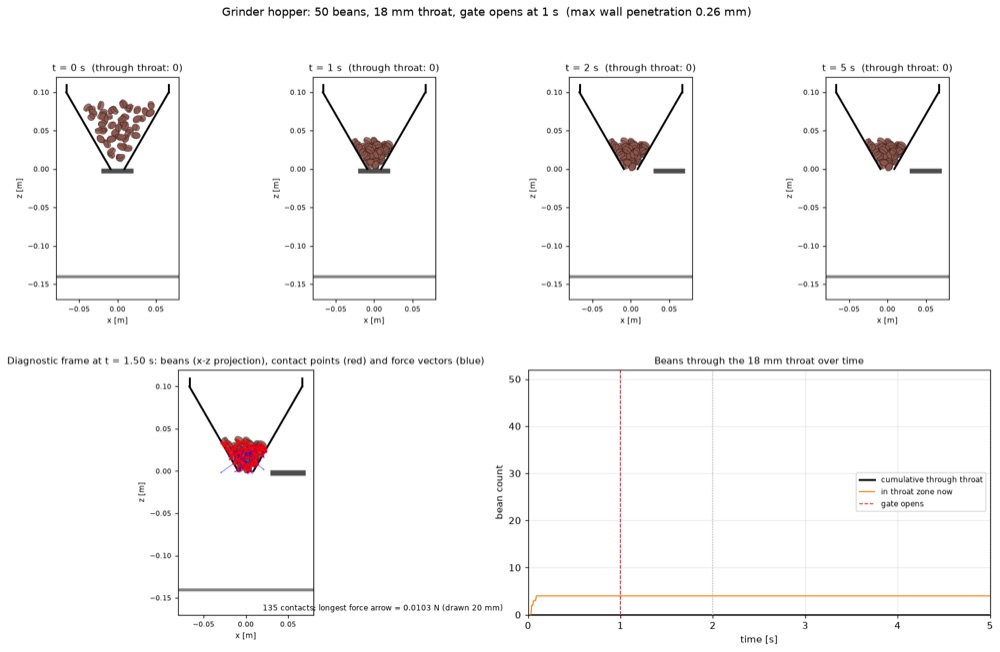
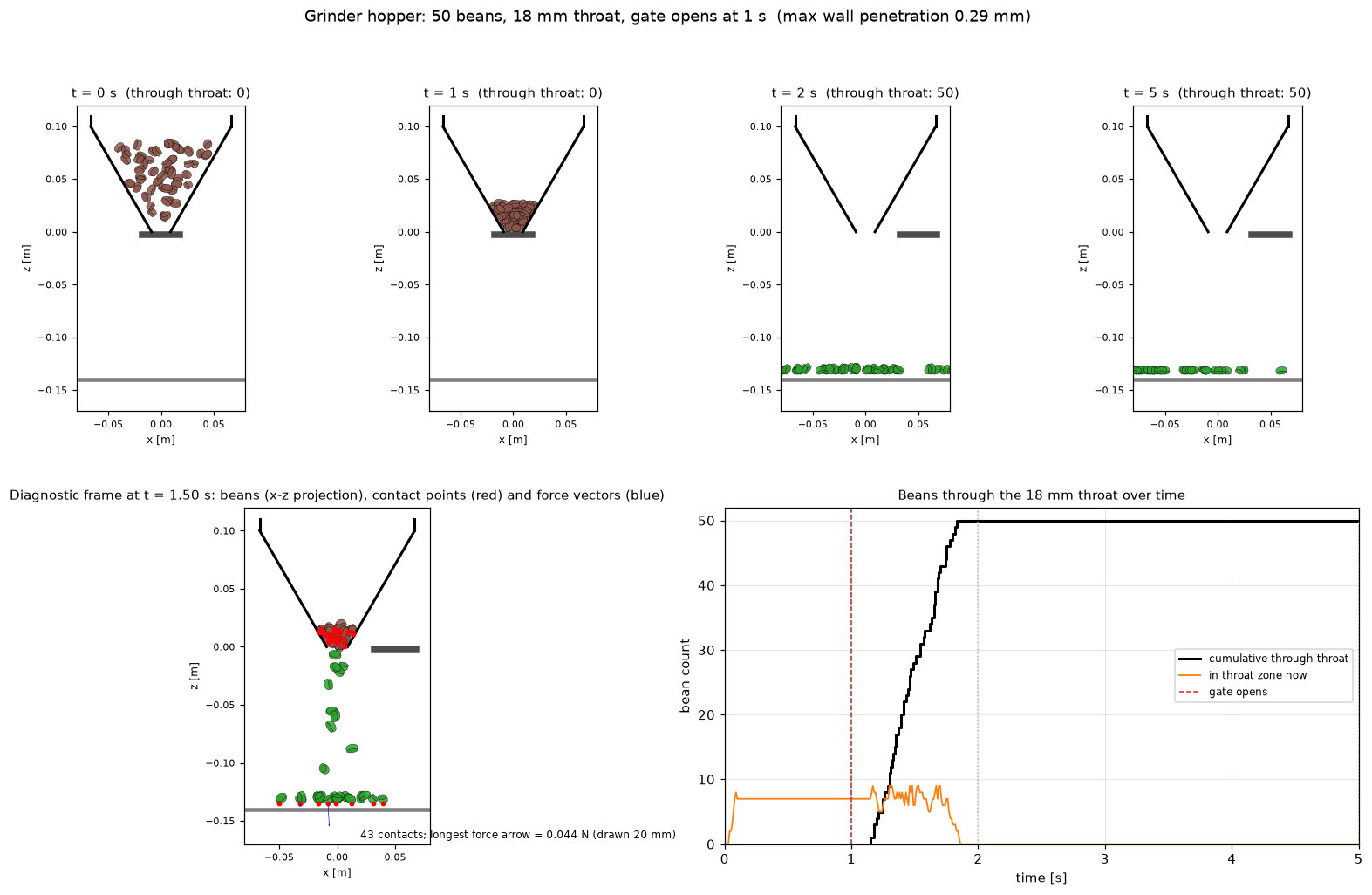
Its first beans jammed in the throat, so it made them smaller, and all 50 are out between 1 and 2 s.
modelanthropic/claude-haiku-5.5taskmujoco-grinder-hopper@v1, checks c1, harness h1date2026-10-15rounds2 of 8 allowed, 12 minutes on the clockcost$0.0306thinkingmediumtokens183,410 in, 51,936 out, of which 41,140 reasoningtime8 min 13 s
Runs in MuJoCodecided by a number, from the filepass
model.xml writtendecided by a number, from the filepass
Fifty two-part beansdecided by a number, from the filepass
Gravity downdecided by a number, from the filepass
Beans start inside a hollow hopperdecided by a number, from the filepass
Held, then flowsdecided by Claude Opus 5.5, GPT-6.1 Sol and Gemini 4 Argon, looking · Pass if the frames and the printed count show no bean through the throat at 1 s, beans coming through by 2 s, all 50 through by 5 s, and none falling out of the model. A count the frames contradict fails it.pass
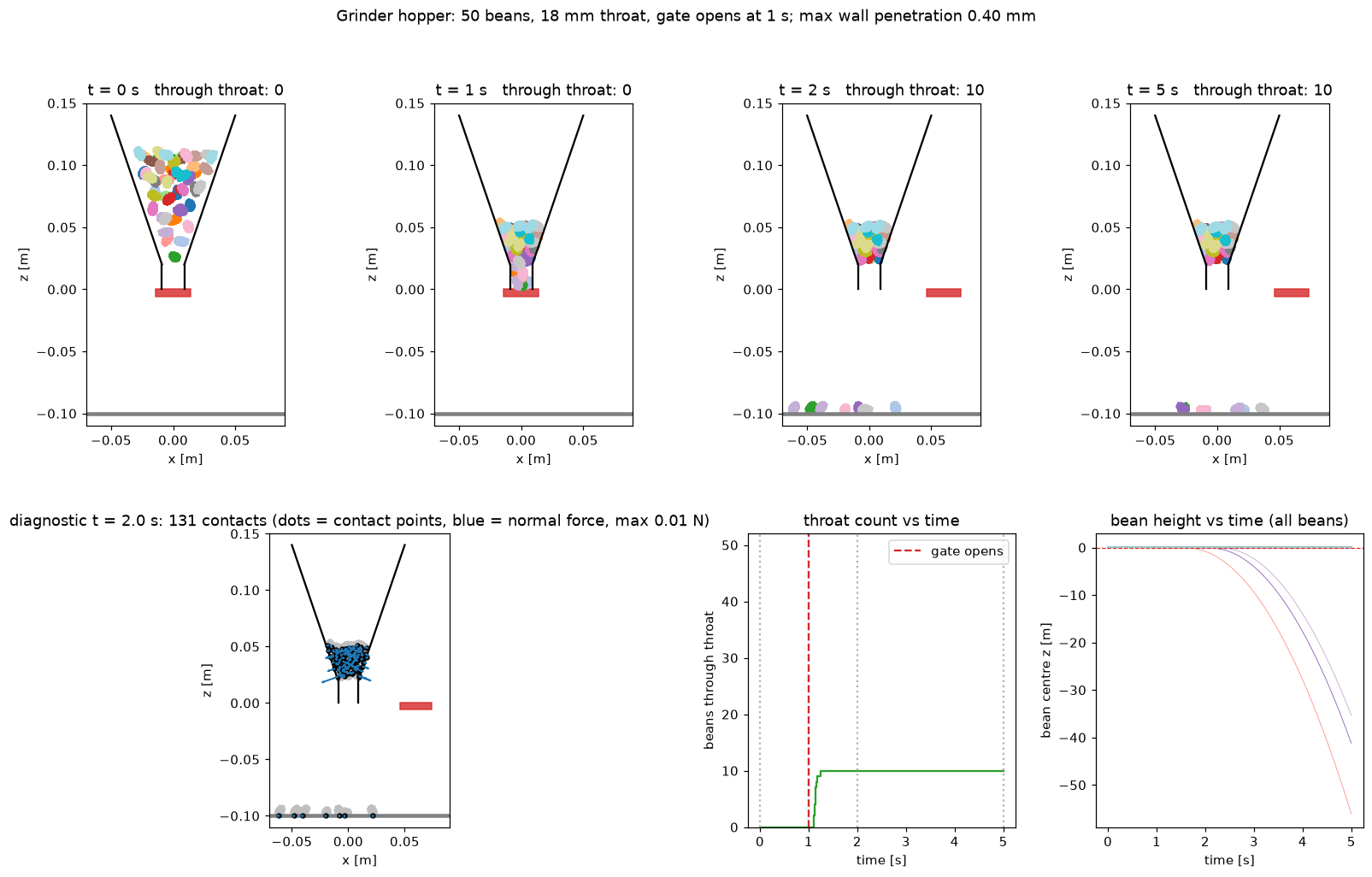 run 1 · 2r · $0.0258Only 10 of the 50 beans get out by 5 s, and beans 19, 20 and 24 fall through the tray and out of the model.
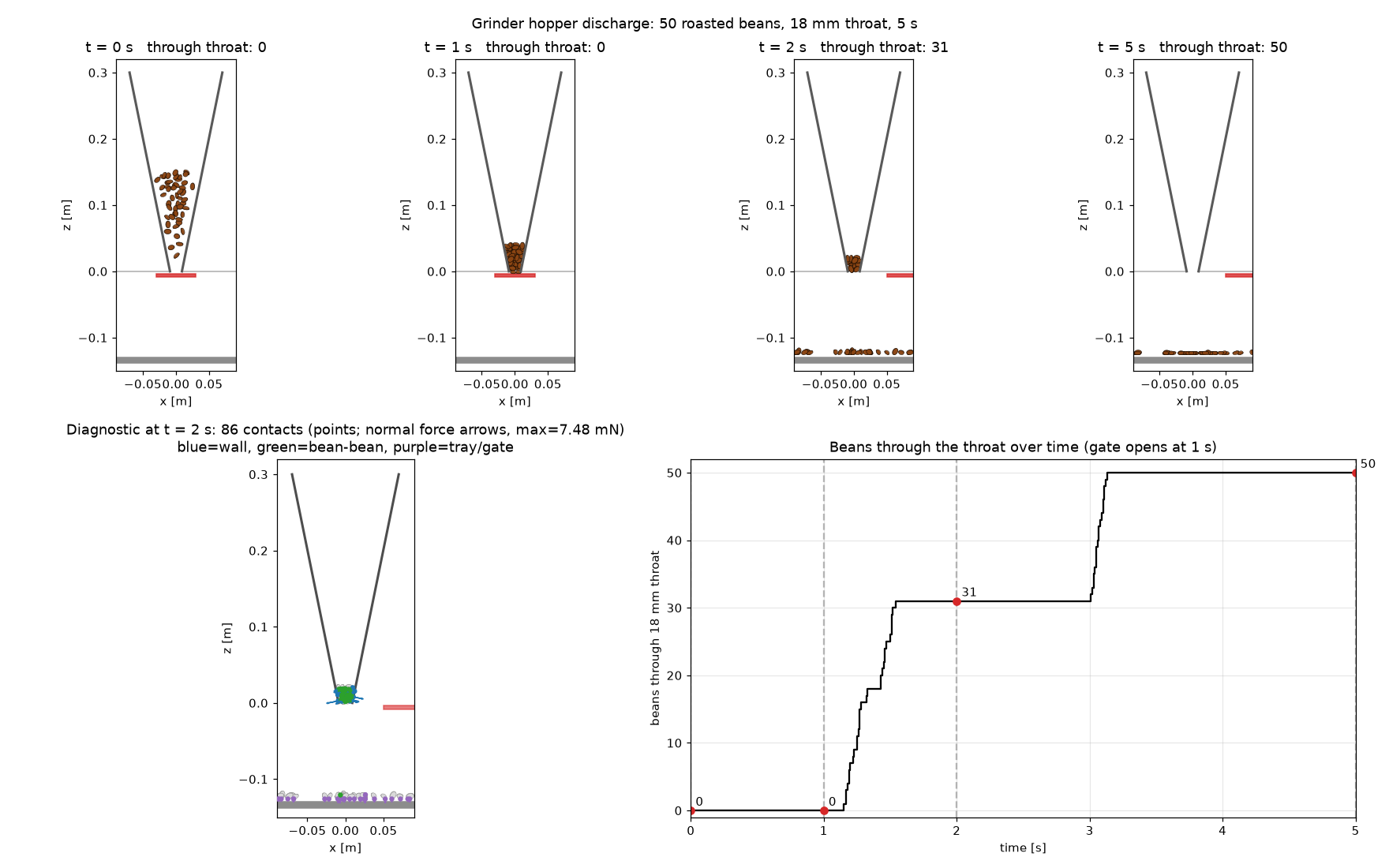 run 3 · 1r · $0.0176Held until 1 s, then 31 out by 2 s and all 50 by 5 s, after a jam in the throat clears.
same prompt, other modelsall 13 runs on Beans leaving a grinder hopper, in MuJoCo →
Build a MuJoCo model of a grinder hopper releasing 50 roasted coffee beans through an 18 mm throat onto a tray, and simulate 5 s of it. Each bean is one free body made of two overlapping ellipsoids, giving it one flat face and one domed face. The hopper is a cone narrowing to the throat; a sliding gate under the throat opens at 1 s. Declare bean size, mass, friction and solver settings. Draw the hopper at 0, 1, 2 and 5 s, a diagnostic frame carrying contact points and force vectors, and beans through the throat over time. One figure, saved to the path in the OUT environment variable. Write the MJCF out to model.xml beside the script. Print the maximum penetration into the hopper walls, the count through the throat at each drawn time, and any bean that left the model.Frozen at v1. This model got this and nothing else.
The model.xml the script writes, loaded in MuJoCo and probed with rays against what a bean can actually hit. MuJoCo collides a mesh as its convex hull, so a cone made of one mesh is solid, and the probe counts it that way. The checker never runs the simulation, so whether the gate holds the beans and then lets them all out is judged by Claude Opus 5.5, GPT-6.1 Sol and Gemini 4 Argon, each shown the brief, the figure, the printed count and the rule, and never which model made it. On 2026-10-16 all three agreed on all ten results, and with the verdicts first published, for $0.52. The rule was written after Claude Opus 5.5 had looked at the runs. How it is scored, and this run's files on GitHub.