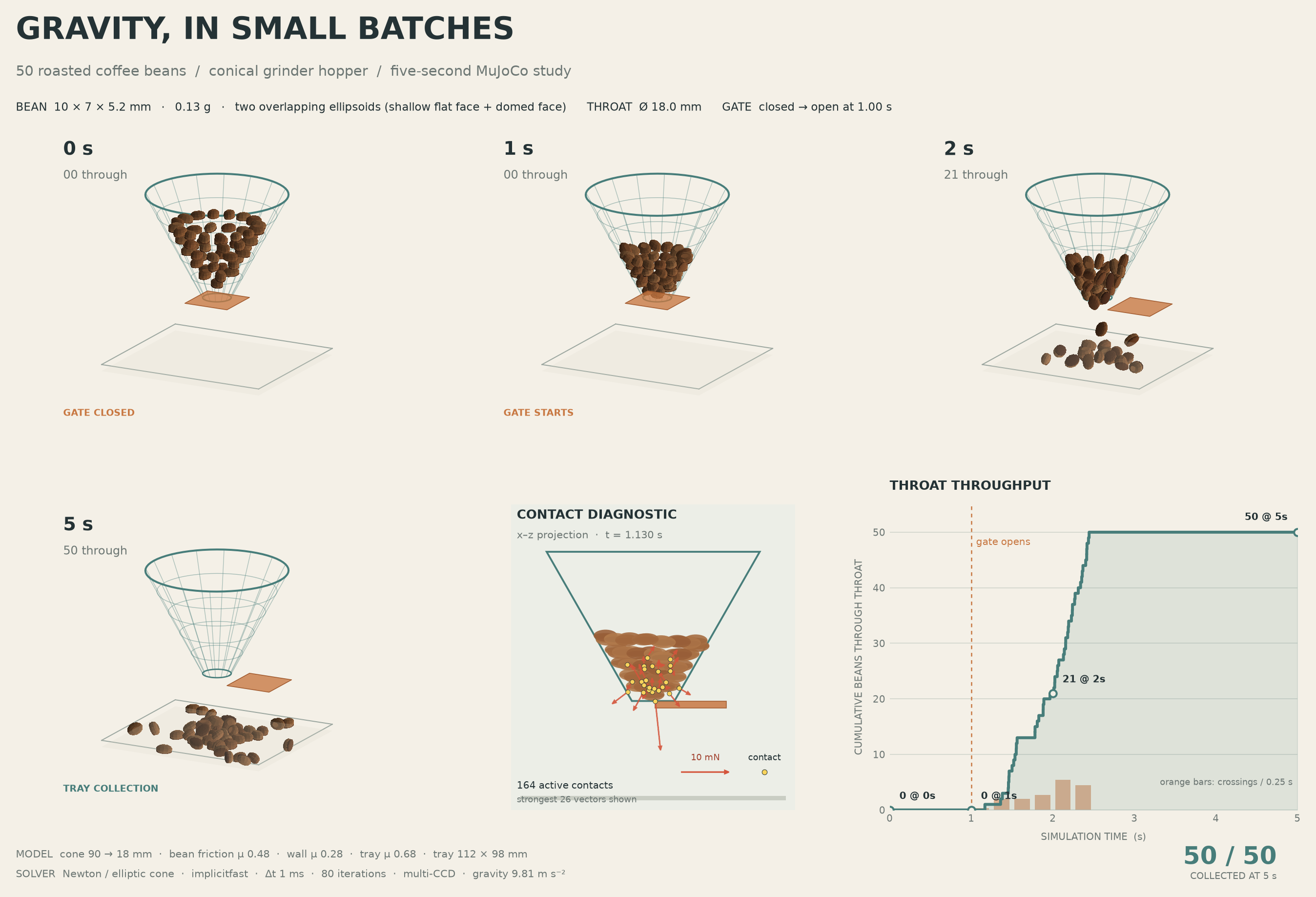
hopper.py · 412 lines
#!/usr/bin/env python3
"""MuJoCo simulation and technical visualisation of a coffee grinder hopper."""
from pathlib import Path
import os
import math
import numpy as np
import mujoco
import matplotlib
matplotlib.use("Agg")
import matplotlib.pyplot as plt
from matplotlib.collections import PolyCollection
from mpl_toolkits.mplot3d.art3d import Poly3DCollection
from matplotlib.patches import Polygon, Ellipse, Rectangle, FancyArrowPatch
from matplotlib.lines import Line2D

# ------------------------------- declared model -------------------------------
N_BEANS = 50
BEAN_LENGTH, BEAN_WIDTH, BEAN_THICKNESS = 10.0, 7.0, 5.2  # mm, overall envelope
BEAN_MASS_G = 0.13
THROAT_DIAMETER_MM = 18.0
DT = 0.001
DURATION = 5.0
GATE_TIME = 1.0
R_BOTTOM, R_TOP = 0.009, 0.045
Z_BOTTOM, Z_TOP = 0.042, 0.105
THROAT_PLANE = 0.039
OUT = Path(os.environ.get("OUT", "hopper.png"))
XML_PATH = Path(__file__).resolve().with_name("model.xml")
RNG = np.random.default_rng(20250308)

BG = "#f4f0e7"
INK = "#243235"
MUTED = "#6d7774"
HOPPER = "#477d7a"
COPPER = "#c87842"
COFFEE = ["#704329", "#7d4a2b", "#875333", "#633b27", "#925b35"]
DOME = ["#a66d42", "#ad7548", "#9a6039", "#b17a4c", "#a3693e"]


def initial_beans():
    """Six close-packed layers; long axes initially approximately horizontal."""
    counts = [1, 5, 6, 10, 12, 16]
    radii = [0.0, 0.0090, 0.0135, 0.0180, 0.0220, 0.0260]
    result = []
    for layer, (count, radius) in enumerate(zip(counts, radii)):
        z = 0.050 + layer * 0.007
        phase = 0.43 * layer
        for j in range(count):
            a = phase + 2 * np.pi * j / count
            x, y = radius * np.cos(a), radius * np.sin(a)
            # modest tilts preserve separation while breaking symmetry
            tilt_x, tilt_y = RNG.uniform(-0.20, 0.20, 2)
            yaw = a + RNG.uniform(-0.8, 0.8)
            result.append((x, y, z, tilt_x, tilt_y, yaw))
    assert len(result) == N_BEANS
    return result


def rotation_matrix(x_axis, y_axis, z_axis):
    return np.column_stack((x_axis, y_axis, z_axis))


def quat_from_matrix(R):
    q = np.empty(4)
    mujoco.mju_mat2Quat(q, R.ravel())
    return " ".join(f"{v:.10f}" for v in q)


def make_xml():
    wall_geoms = []
    nwall = 64
    dz = Z_TOP - Z_BOTTOM
    dr = R_TOP - R_BOTTOM
    slant = math.hypot(dz, dr)
    rmid = (R_TOP + R_BOTTOM) / 2
    zmid = (Z_TOP + Z_BOTTOM) / 2
    for i in range(nwall):
        a = 2 * np.pi * i / nwall
        radial = np.array([np.cos(a), np.sin(a), 0.0])
        tangent = np.array([-np.sin(a), np.cos(a), 0.0])
        up = (dr * radial + dz * np.array([0., 0., 1.])) / slant
        outward = np.cross(tangent, up)
        # Inner tangent surface lies on the nominal cone; 0.6 mm wall thickness.
        pos = rmid * radial + 0.00030 * outward + np.array([0., 0., zmid])
        quat = quat_from_matrix(rotation_matrix(outward, tangent, up))
        half_width = R_TOP * np.tan(np.pi / nwall) + 0.00008
        wall_geoms.append(
            f'<geom name="wall_{i:02d}" class="hopper_wall" type="box" '
            f'size="0.00030 {half_width:.8f} {slant/2 + 0.0002:.8f}" '
            f'pos="{pos[0]:.8f} {pos[1]:.8f} {pos[2]:.8f}" quat="{quat}"/>')

    bean_bodies = []
    for i, (x, y, z, rx, ry, rz) in enumerate(initial_beans()):
        # XYZ intrinsic Euler angles are sufficient for the initial orientations.
        bean_bodies.append(f'''
    <body name="bean_{i:02d}" pos="{x:.7f} {y:.7f} {z:.7f}" euler="{rx:.5f} {ry:.5f} {rz:.5f}">
      <freejoint name="bean_free_{i:02d}"/>
      <geom name="bean_{i:02d}_flat" class="bean" type="ellipsoid"
            size="0.0048 0.0034 0.00125" pos="0 0 -0.00055"
            rgba="0.30 0.13 0.065 1"/>
      <geom name="bean_{i:02d}_dome" class="bean" type="ellipsoid"
            size="0.0050 0.0035 0.00250" pos="0 0 0.00090"
            rgba="0.56 0.29 0.13 1"/>
      <inertial pos="0 0 0" mass="{BEAN_MASS_G/1000:.8f}"
                diaginertia="1.4e-8 2.2e-8 3.1e-8"/>
    </body>''')

    xml = f'''<?xml version="1.0" encoding="utf-8"?>
<mujoco model="50 roasted beans | 18 mm grinder hopper">
  <compiler angle="radian" coordinate="local" autolimits="true"/>
  <option timestep="{DT}" gravity="0 0 -9.81" integrator="implicitfast"
          solver="Newton" iterations="80" tolerance="1e-9"
          cone="elliptic" jacobian="sparse" impratio="1.4">
    <flag warmstart="enable" multiccd="enable"/>
  </option>
  <default>
    <default class="bean">
      <!-- Roasted coffee: 10 x 7 x 5.2 mm, 0.13 g; shallow flat + tall dome. -->
      <geom contype="1" conaffinity="1" friction="0.48 0.015 0.002"
            solref="0.003 1" solimp="0.94 0.99 0.001" margin="0.00005"/>
    </default>
    <default class="hopper_wall">
      <geom contype="1" conaffinity="1" friction="0.28 0.01 0.001"
            solref="0.003 1" solimp="0.96 0.995 0.001" rgba="0.20 0.43 0.42 0.32"/>
    </default>
    <default class="tray">
      <geom friction="0.68 0.02 0.003" solref="0.004 1" rgba="0.72 0.73 0.68 1"/>
    </default>
  </default>
  <worldbody>
    <light directional="true" pos="0.1 -0.2 0.3" dir="-0.2 0.3 -1" diffuse="0.8 0.8 0.8"/>
    <geom name="tray_floor" class="tray" type="box" size="0.056 0.049 0.002" pos="0 0 0"/>
    <geom name="tray_front" class="tray" type="box" size="0.056 0.0015 0.005" pos="0 -0.049 0.004"/>
    <geom name="tray_back" class="tray" type="box" size="0.056 0.0015 0.005" pos="0 0.049 0.004"/>
    <geom name="tray_left" class="tray" type="box" size="0.0015 0.049 0.005" pos="-0.056 0 0.004"/>
    <geom name="tray_right" class="tray" type="box" size="0.0015 0.049 0.005" pos="0.056 0 0.004"/>
    {''.join(wall_geoms)}
    <body name="sliding_gate" mocap="true" pos="0 0 0.0405">
      <geom name="gate" type="box" size="0.015 0.015 0.0015" pos="0 0 0"
            friction="0.32 0.01 0.001" solref="0.003 1" rgba="0.78 0.35 0.12 1"/>
    </body>
  </worldbody>
  <worldbody>
    {''.join(bean_bodies)}
  </worldbody>
</mujoco>
'''
    # MJCF permits only one worldbody: merge the two construction blocks.
    xml = xml.replace("  </worldbody>\n  <worldbody>\n", "\n")
    XML_PATH.write_text(xml)
    return xml


def simulate():
    model = mujoco.MjModel.from_xml_string(make_xml())
    data = mujoco.MjData(model)
    mujoco.mj_forward(model, data)
    gate_id = model.body("sliding_gate").id
    bean_ids = [model.body(f"bean_{i:02d}").id for i in range(N_BEANS)]
    bean_jids = [model.joint(f"bean_free_{i:02d}").id for i in range(N_BEANS)]
    wall_gid = {model.geom(f"wall_{i:02d}").id for i in range(64)}
    wanted = {0.0, 1.0, 2.0, 5.0}
    snapshots = {}
    crossings = np.full(N_BEANS, np.nan)
    prev_z = np.array([data.xpos[b, 2] for b in bean_ids])
    max_penetration = 0.0
    max_penetration_time = 0.0
    diagnostic = None
    diagnostic_score = -1
    escaped = set()
    total_steps = int(DURATION / DT)

    def capture(t):
        snapshots[t] = {
            "xpos": data.xpos[bean_ids].copy(),
            "xmat": data.xmat[bean_ids].reshape(N_BEANS, 3, 3).copy(),
            "gate": data.mocap_pos[model.body_mocapid[gate_id]].copy(),
        }

    capture(0.0)
    for step in range(1, total_steps + 1):
        t = step * DT
        # A 120 mm/s sliding stroke clears the throat in 0.15 s.
        if t <= GATE_TIME:
            opening = 0.0
        else:
            u = min(1.0, (t - GATE_TIME) / 0.25)
            opening = 0.030 * (u * u * (3 - 2 * u))
        data.mocap_pos[model.body_mocapid[gate_id]] = [opening, 0, 0.0405]
        mujoco.mj_step(model, data)

        z = data.xpos[bean_ids, 2]
        newly = np.where(np.isnan(crossings) & (prev_z >= THROAT_PLANE) & (z < THROAT_PLANE))[0]
        for i in newly:
            frac = (prev_z[i] - THROAT_PLANE) / max(prev_z[i] - z[i], 1e-12)
            crossings[i] = t - DT + frac * DT
        prev_z = z.copy()

        for c in data.contact:
            if c.geom1 in wall_gid or c.geom2 in wall_gid:
                pen = max(0.0, -float(c.dist))
                if pen > max_penetration:
                    max_penetration, max_penetration_time = pen, t

        # Preserve a busy post-opening frame with forces throughout the hopper.
        if 1.10 <= t <= 1.65 and step % 5 == 0:
            contacts = []
            for contact_index, c in enumerate(data.contact):
                force = np.zeros(6)
                mujoco.mj_contactForce(model, data, contact_index, force)
                vec = force[:3] @ np.asarray(c.frame).reshape(3, 3)
                if np.linalg.norm(vec) > 1e-7:
                    contacts.append((c.pos.copy(), vec.copy(), float(np.linalg.norm(vec)), c.geom1, c.geom2))
            score = len(contacts)
            if score > diagnostic_score:
                diagnostic_score = score
                diagnostic = {
                    "time": t, "contacts": contacts,
                    "xpos": data.xpos[bean_ids].copy(),
                    "xmat": data.xmat[bean_ids].reshape(N_BEANS, 3, 3).copy(),
                    "gate": np.array([opening, 0, 0.0405]),
                }

        for i, b in enumerate(bean_ids):
            p = data.xpos[b]
            if (not np.all(np.isfinite(p))) or abs(p[0]) > 0.15 or abs(p[1]) > 0.15 or p[2] < -0.03 or p[2] > 0.20:
                escaped.add(i)
        if any(abs(t - target) < DT / 2 for target in wanted):
            capture(round(t, 3))

    if diagnostic is None:
        raise RuntimeError("No diagnostic contacts recorded")
    times = np.arange(0, DURATION + DT / 2, DT)
    cumulative = np.array([np.sum(np.isfinite(crossings) & (crossings <= t)) for t in times])
    count_at = {t: int(np.sum(np.isfinite(crossings) & (crossings <= t + 1e-9))) for t in wanted}
    print(f"Maximum penetration into hopper walls: {max_penetration*1000:.4f} mm (t = {max_penetration_time:.3f} s)")
    print("Beans through throat: " + ", ".join(f"t={t:g}s: {count_at[t]}/50" for t in sorted(count_at)))
    print("Beans that left the model: " + (", ".join(f"bean_{i:02d}" for i in sorted(escaped)) if escaped else "none"))
    print(f"Diagnostic frame: t={diagnostic['time']:.3f}s, {len(diagnostic['contacts'])} contacts")
    return snapshots, diagnostic, times, cumulative, crossings, count_at


# --------------------------------- drawing ---------------------------------
U, V = np.meshgrid(np.linspace(0, 2*np.pi, 13), np.linspace(0, np.pi, 8))
SPHERE = np.array([np.cos(U)*np.sin(V), np.sin(U)*np.sin(V), np.cos(V)])


def setup_3d(ax):
    ax.set_facecolor(BG)
    ax.set_xlim(-0.058, 0.058)
    ax.set_ylim(-0.052, 0.052)
    ax.set_zlim(-0.002, 0.111)
    ax.set_box_aspect((1.05, 0.95, 1.10))
    ax.view_init(elev=17, azim=-62)
    ax.set_proj_type("ortho")
    ax.set_axis_off()
    ax.dist = 9


def draw_hopper_3d(ax, gate_x=0.0):
    # Tray as a shallow open box.
    xx, yy = np.meshgrid(np.linspace(-.056, .056, 2), np.linspace(-.049, .049, 2))
    # Keep the floor translucent: mplot3d otherwise depth-sorts it over the beans.
    ax.plot_surface(xx, yy, np.full_like(xx, .002), color="#d9d8ca", alpha=.18, shade=False, linewidth=0)
    for x in [-.056, .056]:
        ax.plot([x, x], [-.049, .049], [.006, .006], color="#9ca7a0", lw=.8)
    for y in [-.049, .049]:
        ax.plot([-.056, .056], [y, y], [.006, .006], color="#9ca7a0", lw=.8)
    # Cone: transparent silhouette and regular fabrication rings.
    theta = np.linspace(0, 2*np.pi, 65)
    zrows = np.linspace(Z_BOTTOM, Z_TOP, 6)
    for z in zrows:
        r = R_BOTTOM + (z-Z_BOTTOM)/(Z_TOP-Z_BOTTOM)*(R_TOP-R_BOTTOM)
        ax.plot(r*np.cos(theta), r*np.sin(theta), np.full_like(theta, z), color=HOPPER, lw=.55, alpha=.46)
    for a in np.linspace(0, 2*np.pi, 17)[:-1]:
        ax.plot([R_BOTTOM*np.cos(a), R_TOP*np.cos(a)], [R_BOTTOM*np.sin(a), R_TOP*np.sin(a)], [Z_BOTTOM, Z_TOP], color=HOPPER, lw=.55, alpha=.42)
    ax.plot(R_TOP*np.cos(theta), R_TOP*np.sin(theta), np.full_like(theta, Z_TOP), color=HOPPER, lw=1.6)
    ax.plot(R_BOTTOM*np.cos(theta), R_BOTTOM*np.sin(theta), np.full_like(theta, Z_BOTTOM), color=HOPPER, lw=1.1)
    # Sliding gate, shown as a copper plate below the throat.
    gx = gate_x
    verts = [[(gx-.015,-.015,.0405),(gx+.015,-.015,.0405),(gx+.015,.015,.0405),(gx-.015,.015,.0405)]]
    p = Poly3DCollection(verts, facecolor=COPPER, edgecolor="#9f582c", alpha=.78, linewidth=.6)
    ax.add_collection3d(p)


def draw_beans_3d(ax, positions, rotations):
    # Back-to-front sorting reduces transparency artefacts in the small views.
    order = np.argsort(positions[:, 1])
    for i in order:
        color, dome = COFFEE[i % len(COFFEE)], DOME[i % len(DOME)]
        for size, offset, col in [
            (np.array([.0048,.0034,.00125]), np.array([0,0,-.00055]), color),
            (np.array([.0050,.0035,.00250]), np.array([0,0,.00090]), dome),
        ]:
            pts = SPHERE * size[:, None, None]
            shape = pts.shape
            pts = rotations[i] @ pts.reshape(3, -1)
            pts = pts.reshape(shape) + (positions[i] + rotations[i] @ offset)[:, None, None]
            ax.plot_surface(pts[0], pts[1], pts[2], color=col, linewidth=0, antialiased=False, shade=True, rcount=8, ccount=13)


def draw_snapshot(ax, snap, t, count):
    setup_3d(ax)
    draw_hopper_3d(ax, snap["gate"][0])
    draw_beans_3d(ax, snap["xpos"], snap["xmat"])
    ax.text2D(.01, .96, f"{t:g} s", transform=ax.transAxes, fontsize=15, fontweight="bold", color=INK, va="top")
    ax.text2D(.01, .865, f"{count:02d} through", transform=ax.transAxes, fontsize=9.5, color=MUTED, va="top")
    if t == 0:
        ax.text2D(.01, .06, "GATE CLOSED", transform=ax.transAxes, fontsize=7.5, fontweight="bold", color=COPPER)
    elif t == 1:
        ax.text2D(.01, .06, "GATE STARTS", transform=ax.transAxes, fontsize=7.5, fontweight="bold", color=COPPER)
    elif t == 5:
        ax.text2D(.01, .06, "TRAY COLLECTION", transform=ax.transAxes, fontsize=7.5, fontweight="bold", color=HOPPER)


def draw_diagnostic(ax, diag):
    ax.set_facecolor("#eceee7")
    # x-z section through the actual 3-D contact set.
    cone = np.array([[-R_TOP,Z_TOP],[-R_BOTTOM,Z_BOTTOM],[R_BOTTOM,Z_BOTTOM],[R_TOP,Z_TOP]])
    ax.add_patch(Polygon(cone, closed=True, fill=False, ec=HOPPER, lw=1.5))
    for z in [Z_BOTTOM, Z_TOP]:
        r = R_BOTTOM if z == Z_BOTTOM else R_TOP
        ax.plot([-r,r],[z,z], color=HOPPER, lw=.7, alpha=.5)
    ax.add_patch(Rectangle((diag["gate"][0]-.015,.039),.030,.003,fc=COPPER,ec="#9f582c",lw=.7,alpha=.85))
    ax.add_patch(Rectangle((-.056,0),.112,.002,fc="#c9cdc3",ec="none"))
    # Projected bean silhouettes; each body remains two overlapping ellipses.
    for i in range(N_BEANS):
        p, R = diag["xpos"][i], diag["xmat"][i]
        if p[2] < .003:
            continue
        for size, off, col in [(.0048,.00125,COFFEE[i%5]),(.0050,.0025,DOME[i%5])]:
            c = p + R @ np.array([0,0,off-.00055 if off < .002 else .0009])
            ax.add_patch(Ellipse((c[0],c[2]),2*size,2*off,fc=col,ec="none",alpha=.90,zorder=3))
    contacts = sorted(diag["contacts"], key=lambda c:c[2], reverse=True)
    shown = contacts[:26]
    for p, f, mag, g1, g2 in reversed(shown):
        # Projected physical force, common scale; arrowhead is kept legible.
        scale = 2.0  # metres of arrow per newton; common scale for every vector
        dx, dz = scale*f[0], scale*f[2]
        if abs(dx)+abs(dz) < 1e-7:
            continue
        ax.arrow(p[0],p[2],dx,dz,width=.00010,head_width=.0013,head_length=.0017,
                 length_includes_head=True,color="#d4553c",alpha=.82,zorder=6)
    pts = np.array([c[0] for c in shown])
    if len(pts):
        ax.scatter(pts[:,0],pts[:,2],s=14,fc="#f9d35b",ec=INK,lw=.35,zorder=7)
    ax.set_xlim(-.060,.060)
    ax.set_ylim(-.004,.125)
    ax.set_aspect("equal")
    ax.set_xticks([]); ax.set_yticks([])
    for s in ax.spines.values(): s.set_visible(False)
    ax.text(.02,.985,"CONTACT DIAGNOSTIC",transform=ax.transAxes,fontsize=10.5,fontweight="bold",color=INK,va="top")
    ax.text(.02,.915,f"x–z projection  ·  t = {diag['time']:.3f} s",transform=ax.transAxes,fontsize=8.5,color=MUTED,va="top")
    ax.text(.02,.07,f"{len(contacts)} active contacts",transform=ax.transAxes,fontsize=8,color=INK)
    ax.text(.02,.025,"strongest 26 vectors shown",transform=ax.transAxes,fontsize=7.2,color=MUTED)
    ax.arrow(.012,.012,.020,0,width=.00012,head_width=.0015,head_length=.0018,length_includes_head=True,color="#d4553c")
    ax.text(.022,.017,"10 mN",fontsize=7.2,color="#a34432",ha="center")
    ax.scatter([.047],[.012],s=18,fc="#f9d35b",ec=INK,lw=.4)
    ax.text(.047,.017,"contact",fontsize=7.2,color=INK,ha="center")


def draw_throughput(ax, times, cumulative, crossings, count_at):
    ax.set_facecolor(BG)
    ax.step(times,cumulative,where="post",color=HOPPER,lw=2.4,zorder=3)
    ax.fill_between(times,cumulative,step="post",color=HOPPER,alpha=.12,zorder=2)
    ax.set_xlim(0,5); ax.set_ylim(0,55)
    ax.set_xticks([0,1,2,3,4,5]); ax.set_yticks([0,10,20,30,40,50])
    ax.grid(axis="y",color="#cdd2c9",lw=.6)
    ax.set_xlabel("SIMULATION TIME  (s)",fontsize=8,color=MUTED,labelpad=7)
    ax.set_ylabel("CUMULATIVE BEANS THROUGH THROAT",fontsize=8,color=MUTED,labelpad=7)
    ax.tick_params(labelsize=8,colors=MUTED,length=0)
    for s in ax.spines.values(): s.set_visible(False)
    ax.axvline(1,color=COPPER,lw=1,ls=(0,(3,3)))
    ax.text(1.06,49,"gate opens",fontsize=7.8,color=COPPER,va="top")
    for t in [0,1,2,5]:
        n=count_at[t]
        ax.scatter([t],[n],s=34,fc=BG,ec=HOPPER,lw=1.6,zorder=4)
        xytext = (8,9) if t < 5 else (-8,10)
        ax.annotate(f"{n} @ {t:g}s",(t,n),xytext=xytext,textcoords="offset points",fontsize=8,color=INK,fontweight="bold",ha="left" if t<5 else "right")
    valid=crossings[np.isfinite(crossings)]
    if len(valid):
        bins=np.arange(0,5.0001,.25)
        hist,_=np.histogram(valid,bins)
        # Quiet lower-band bars show instantaneous batches without a second axis.
        ax.bar(bins[:-1]+.125,hist*.34,width=.19,bottom=0,color=COPPER,alpha=.52,zorder=1)
        ax.text(4.94,4.5,"orange bars: crossings / 0.25 s",ha="right",fontsize=7,color=MUTED)
    ax.set_title("THROAT THROUGHPUT",loc="left",fontsize=10.5,fontweight="bold",color=INK,pad=12)


def make_figure(snapshots, diagnostic, times, cumulative, crossings, count_at):
    fig = plt.figure(figsize=(15.6,10.2),facecolor=BG)
    gs = fig.add_gridspec(2,3,left=.035,right=.975,top=.855,bottom=.095,wspace=.08,hspace=.23)
    for ax,t in zip([fig.add_subplot(gs[0,i],projection="3d") for i in range(3)],[0.0,1.0,2.0]):
        draw_snapshot(ax,snapshots[t],t,count_at[t])
    draw_snapshot(fig.add_subplot(gs[1,0],projection="3d"),snapshots[5.0],5.0,count_at[5.0])
    draw_diagnostic(fig.add_subplot(gs[1,1]),diagnostic)
    draw_throughput(fig.add_subplot(gs[1,2]),times,cumulative,crossings,count_at)
    fig.text(.04,.955,"GRAVITY, IN SMALL BATCHES",fontsize=25,fontweight="bold",color=INK,ha="left")
    fig.text(.04,.914,"50 roasted coffee beans  /  conical grinder hopper  /  five-second MuJoCo study",fontsize=11.5,color=MUTED,ha="left")
    fig.text(.04,.875,"BEAN  10 × 7 × 5.2 mm   ·   0.13 g   ·   two overlapping ellipsoids (shallow flat face + domed face)      THROAT  Ø 18.0 mm      GATE  closed → open at 1.00 s",fontsize=9.3,color=INK)
    fig.text(.04,.042,"MODEL  cone 90 → 18 mm  ·  bean friction μ 0.48  ·  wall μ 0.28  ·  tray μ 0.68  ·  tray 112 × 98 mm",fontsize=8.4,color=MUTED)
    fig.text(.04,.020,"SOLVER  Newton / elliptic cone  ·  implicitfast  ·  Δt 1 ms  ·  80 iterations  ·  multi-CCD  ·  gravity 9.81 m s⁻²",fontsize=8.4,color=MUTED)
    fig.text(.96,.035,f"{count_at[5.0]} / 50",fontsize=20,fontweight="bold",color=HOPPER,ha="right")
    fig.text(.96,.018,"COLLECTED AT 5 s",fontsize=7.5,color=MUTED,ha="right")
    fig.savefig(OUT,dpi=180,facecolor=BG,bbox_inches="tight",pad_inches=.18)
    print(f"Figure saved to {OUT}")
    print(f"MJCF saved to {XML_PATH}")


if __name__ == "__main__":
make_figure(*simulate())Beans leaving a grinder hopper, in MuJoCo: Kimi K3.1 Pro
There is no post about this one, since only some results need one, so the picture, the source and the scoring are here instead.
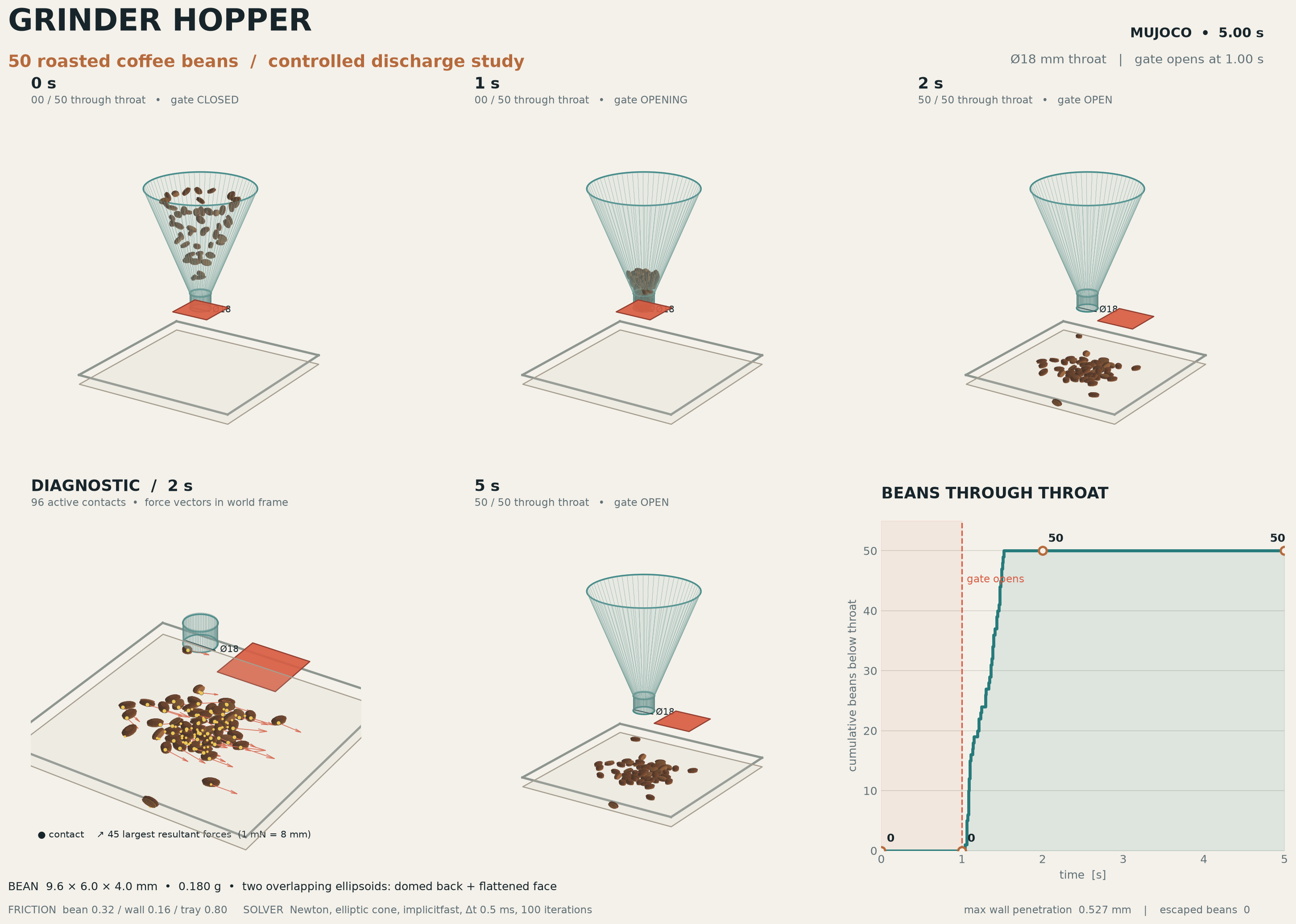 run 1 · 7r · $0.3155
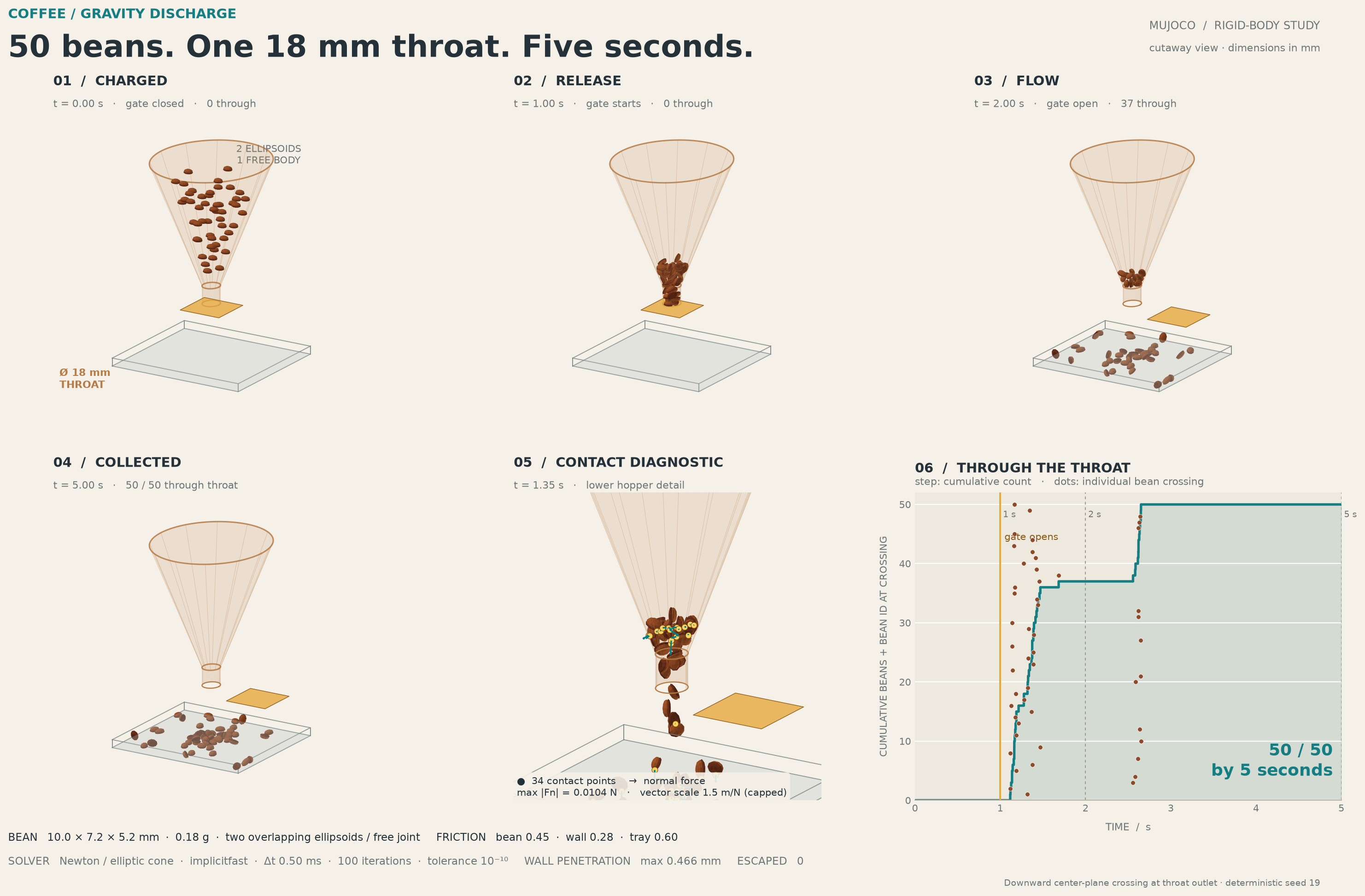 run 3 · 7r · $0.3257
Build a MuJoCo model of a grinder hopper releasing 50 roasted coffee beans through an 18 mm throat onto a tray, and simulate 5 s of it. Each bean is one free body made of two overlapping ellipsoids, giving it one flat face and one domed face. The hopper is a cone narrowing to the throat; a sliding gate under the throat opens at 1 s. Declare bean size, mass, friction and solver settings. Draw the hopper at 0, 1, 2 and 5 s, a diagnostic frame carrying contact points and force vectors, and beans through the throat over time. One figure, saved to the path in the OUT environment variable. Write the MJCF out to model.xml beside the script. Print the maximum penetration into the hopper walls, the count through the throat at each drawn time, and any bean that left the model.Frozen at v1. This model got this and nothing else.
The model.xml the script writes, loaded in MuJoCo and probed with rays against what a bean can actually hit. MuJoCo collides a mesh as its convex hull, so a cone made of one mesh is solid, and the probe counts it that way. The checker never runs the simulation, so whether the gate holds the beans and then lets them all out is judged by Claude Opus 5.5, GPT-6.1 Sol and Gemini 4 Argon, each shown the brief, the figure, the printed count and the rule, and never which model made it. On 2026-10-16 all three agreed on all ten results, and with the verdicts first published, for $0.52. The rule was written after Claude Opus 5.5 had looked at the runs. How it is scored, and this run's files on GitHub.